
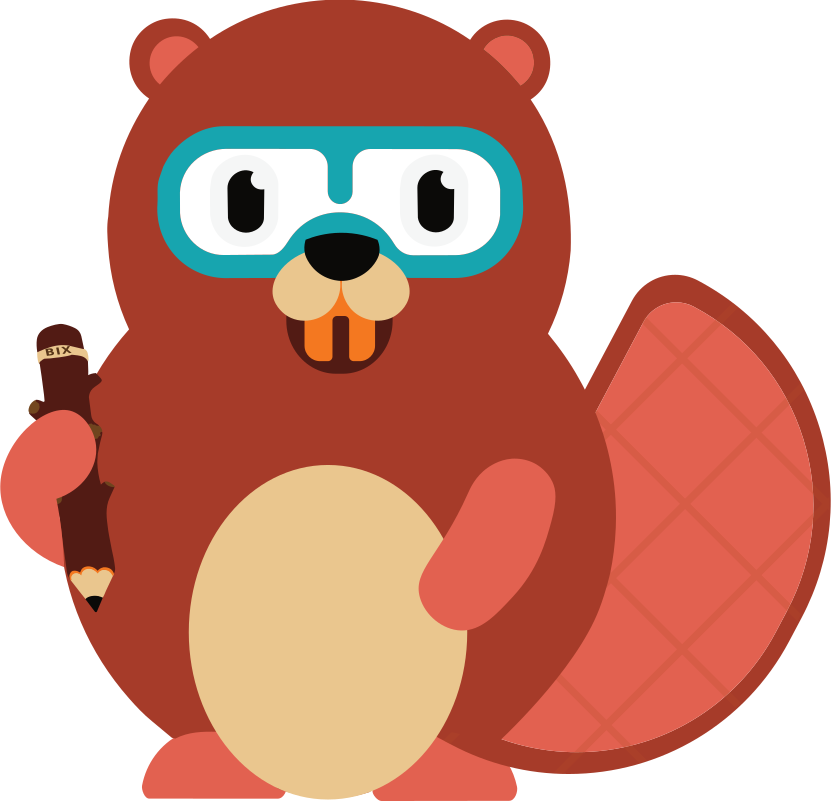
The beaver in the goggles

Hi. I’m Bix.

A beaver in swimming goggles, holding a pencil he sharpened himself. One is for understanding what is already there. The other is for making something that isn’t.

The goggles are real. The orange teeth are real. The engineering is real. The only thing we invented is his name.

Bix, a beaver in swimming goggles, holding his pencil

Where you actually meet him

Four moments. These are the words already on the screens.

Making a book

“Let Bix choose.”

Don’t want to decide every last thing? He picks it — and then shows you what he picked, marked Chosen by Bix, so nothing happens behind your back.

Reading it

“Ask Bix.”

A word goes cloudy. Your child taps it and it clears, without leaving the page or going to find a grown-up.

Building a workbook

“Let Bix make it personal.”

He puts the people your child already knows into the questions, and checks the topic is safe for a child and big enough to carry a full set.

Finishing one

He turns up and celebrates.

For finishing it. Never for the score — a child is never told they are ahead or behind here.

Eight true things about a beaver

Bix says one thing about each. Then we say what it actually means for the book you would get.

The goggles aren’t a costume.

A beaver has a third eyelid — clear, like a shutter — that slides across each eye underwater. He can see while he works, down in water nobody else can see through. He was born wearing them.

Bix says

“A word you don’t know is just a cloudy bit of water. Luckily I have goggles. They came free with my face.”

What that means here

Here is a child’s murky water: a word they don’t know. The sentence goes cloudy, and they either stop reading or skip it and hope. That is the exact water Bix can see in. They tap the word, choose Ask Bix, and it clears — without leaving the page, and without having to go and find a grown-up.

The teeth are orange because of iron.

There is iron in the enamel of a beaver’s front teeth. That is the orange. It also makes them harder than the wood they cut. The front of each tooth is harder than the back, so every bite wears them into a fresh chisel edge — they sharpen themselves by being used.

Bix says

“I have been told the colour is unusual. I have decided to file it under equipment.”

What that means here

It is our orange too, and we keep it for one job: marking what your child earned — a chapter finished, an answer they got right. It never goes on a button asking you to buy anything. We never sell to a child, so the colour that means “well done” can never also mean “pay us”.

The pencil is a stick he sharpened himself.

A beaver does not pick up sticks. He makes them. A tree he has cut down does not end in a flat stump — it ends in a point, because those chisel teeth work round and round it until what is left is, unmistakably, a sharpened pencil. The pencil in his paw is a thing he made with his own face.

Bix says

“This pencil and I have been through a lot together. Mostly my teeth.”

What that means here

This is the half people miss. Your child does not only read the book — they make it. They choose who is in it, what it is about, and what it looks like, and it gets drawn from that. That is pencil work, and it is why he carries one.

They never stop growing.

A beaver’s front teeth grow for his whole life. He does not chew wood only because he is hungry — he chews because teeth he stops using grow past the length he can use them at.

Bix says

“I chew wood daily. The alternative is a dental situation I would rather not describe over breakfast.”

What that means here

It is why a BespokeTales book does not stop at the last page. Whatever your child was learning inside the story comes back afterwards as practice they can actually do. Teeth you stop using grow too long to use. A lesson met once and never again has the same problem.

The tree grows back.

Cut a willow or an aspen and the stump does not die. It sends up a ring of new shoots, often thicker than what was there before. Beavers come back to the same trees year after year, and the trees keep coming.

Bix says

“I visit the same tree every year. It keeps growing back. At this point I have stopped asking why and started taking it personally.”

What that means here

It is how we teach one thing twice. Halves and quarters turn up in a bakery. In the next book they turn up on a rocket — new story, new numbers, same lesson. Cutting the same tree again is how it grows.

The tail is four tools, and one of them steers.

Flat and scaly, like a leather paddle. It is a rudder for steering. A prop to lean on while he stands up to cut. A store of fat for the lean months. And brought down flat on the water, it is a bang that every beaver in earshot hears and answers.

Bix says

“It steers, it holds me upright, it stores my snacks, and it is a telephone. Four jobs, one tail. No, I will not be answering questions about sitting down.”

What that means here

The rudder is the one we mean. A rudder is the thing that decides which way you go — without one, the water decides for you. You are the rudder here. You pick what your child is learning, who is in the story with them, and where it happens. Nothing picks that for you and tells you afterwards.

Nobody builds a lodge alone.

A lodge and its dam are built by the whole family — the parents, this year’s young, and last year’s young, all working the same wall. The young ones learn it by hauling sticks next to the adults, not by watching from the bank.

Bix says

“The little ones carry the small sticks. Yesterday one of them fixed a wall I built. I have decided to be proud instead of asking questions.”

What that means here

Personalized story apps put one child in one story. We put the people they love in it with them — the brother, the grandmother, the dog — and the lesson inside the plot. A colony is never one beaver. Neither is a family.

“Nature’s engineer” isn’t flattery.

One dam turns a stream into a pond, and the pond becomes home to frogs, dragonflies, herons, fish and moose that were not there before. Ecologists have a name for an animal whose building makes a place for hundreds of others: a keystone species.

Bix says

“I built one wall. Everybody moved in. I would like it on the record that nobody asked me first.”

What that means here

Bespoke means built to fit one person. We do not take a story off a shelf and swap the name in — every book is built from nothing, around one family. And like the pond: what gets built ends up being a place the whole family lives in.

The colours are his, too.

Our palette is not a mood board. It is a beaver in a pond.

Beaver Brown

His fur at its darkest. Every other colour stands on it.

Tooth Orange

The iron in his teeth. In the app it marks what your child earned.

Bix Cyan

The goggles. His signature, worn nowhere else.

Cream

The paper the story is printed on.

So, why a beaver?

Because bespoke means built to fit one person, and the beaver is the animal the word “builder” belongs to.

He does not find a home. He builds one, out of whatever is on the bank, for the family he actually has. He does not build it alone. And what he builds turns into a place everyone else gets to live in. All three of those are true of what happens when you make a book here.

The other half of the answer: every animal we could have picked instead stands for being clever. We did not want clever. Bix is never the cleverest one in the room — your child is. He is the one who gets it wrong cheerfully, so your child is always the one who works it out.

One thing Bix isn’t

He never turns up inside your child’s book. He hands it over and steps out of the frame. The heroes in there are your family, and he is not competing with them for a page.